Walnut Creek Watershed Learning Network

New Paragraph

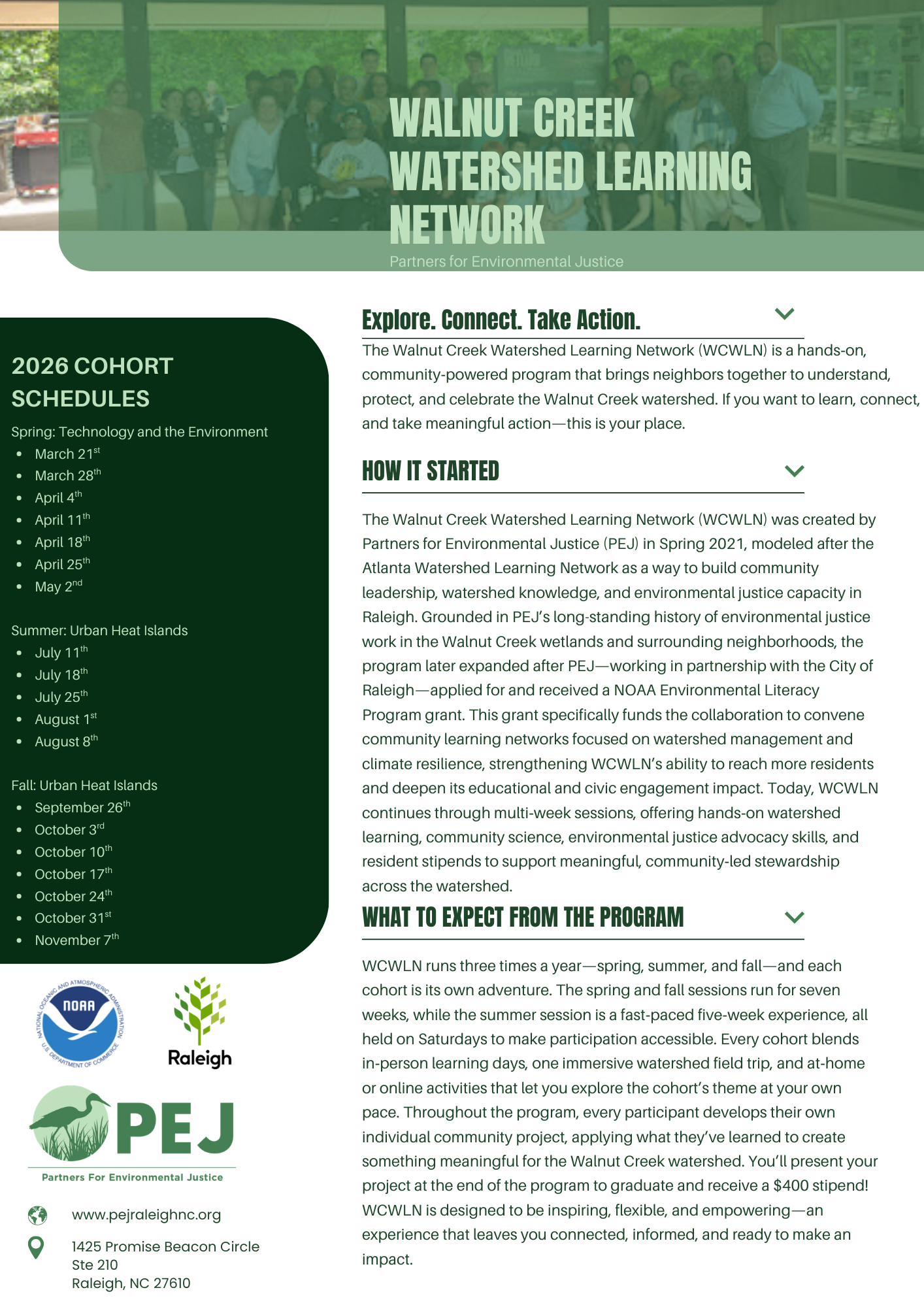
Spring 2026 Registration is Closed! Be on the lookout for our Summer and Fall registration.

A silhouette of a bird flying over a body of water.

The Spring 2026 cohort is grounded in the theme of "Tech‑Powered Environmental Stewardship", exploring the deep, complex, and often intersectional relationship between technology and the environment. This year’s program invites participants to examine how digital tools both shape and respond to environmental conditions—revealing patterns of energy use, flooding, land change, and neighborhood‑level disparities that influence watershed health. By understanding how technology intersects with community experience, infrastructure, and environmental justice, participants learn not only how to read data, but how to interpret what it means for the places they live, work, and gather. Participants will:


- Hear directly from professionals working at the intersection of technology and ecology

- Participate in hands‑on activities and demonstrations

- Learn how mapping tools, sensors, online platforms, and other emerging technologies help us understand and protect the Walnut Creek watershed


Community Project:

Throughout the program, every participant develops their own individual community project—an opportunity to apply what you’ve learned and make a meaningful impact in the Walnut Creek watershed. You’ll design your project, receive support and guidance along the way, and present it at the end of the program to graduate and receive a $400 stipend.


This is your chance to create something rooted in your interests, your neighborhood, and your vision for a healthier, more connected watershed community.


Spring 2026 WCWLN Schedule

ALL SESSIONS TAKE PLACE ON SATURDAYS. IN‑PERSON SESSIONS RUN FROM 11:00 AM TO 2:00 PM, WITH GRADUATION DAY ENDING AT 3:00 PM.


March 21 — In‑Person Session


March 28 — Self‑Guided Learning


April 4 — Virtual Session (Microsoft Teams)


April 11 — Self‑Guided Learning


April 18 — Field Trip: Lake Johnson


April 25 — In‑Person Session: Community Project Round 1


May 2 — In‑Person Session: Community Project Round 2 & Graduation


Featuring keynote speaker Jevon Smith, Research Computing Manager at NC State University and recent candidate for Raleigh City Council (Ward D).


Image showing three logos with text describing NOAA-funded community climate education activities: PEJ, Raleigh, and North Carolina's Climate Office.

Empowering Communities Through Watershed Education: The Walnut Creek Watershed Learning Network

PEJ's Walnut Creek Watershed Learning Network (WCWLN) is a six-week, cohort-style community education and empowerment initiative that PEJ first implemented in Spring 2021, based on the innovative Atlanta Watershed Learning Network model. The program empowers watershed residents with knowledge of environmental justice and civic engagement. Each cohort focuses on a specific environmental issue—ranging from water quality to heat islands—and, as part of the graduation requirements, participants must design, complete, and present a community project related to their cohort’s area of focus.
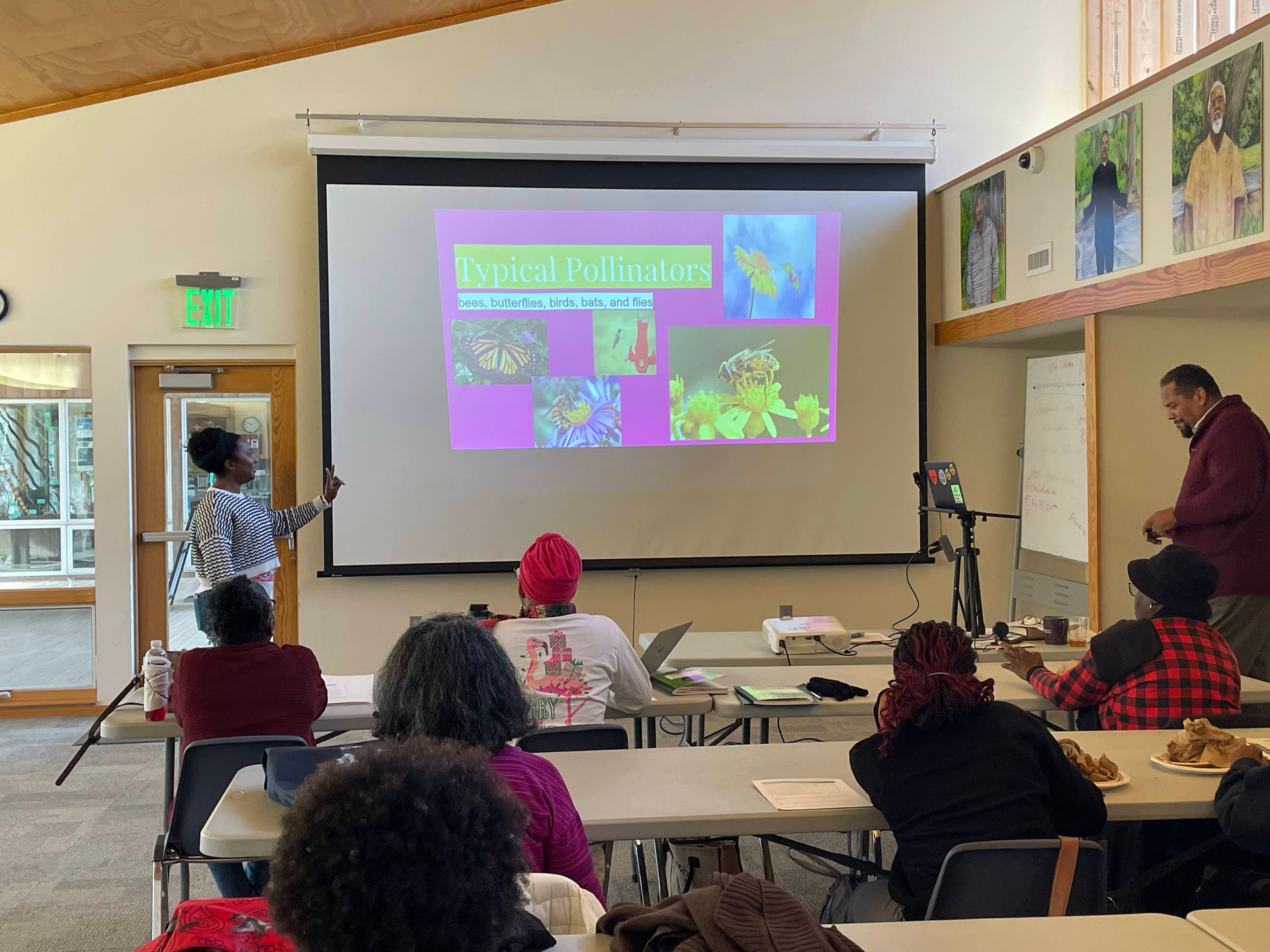
A workshop in a brightly lit room. Two presenters stand in front, facing a seated audience. A projector screen displays a blue image.
A hand cupping soil and a seedling with two leaves.

Educating participants about various topics such as stormwater management, green infrastructure and environmental justice

A person icon surrounded by interconnected circles, symbolizing a network or community.

Making connections about why these topics are important to them and their communities

Icon of two hands shaking inside a circular arrow, with a checkmark inside a circle.

Providing participants with the tools to become more engaged stakeholders and be empowered to take action in protecting the integrity of their communities.

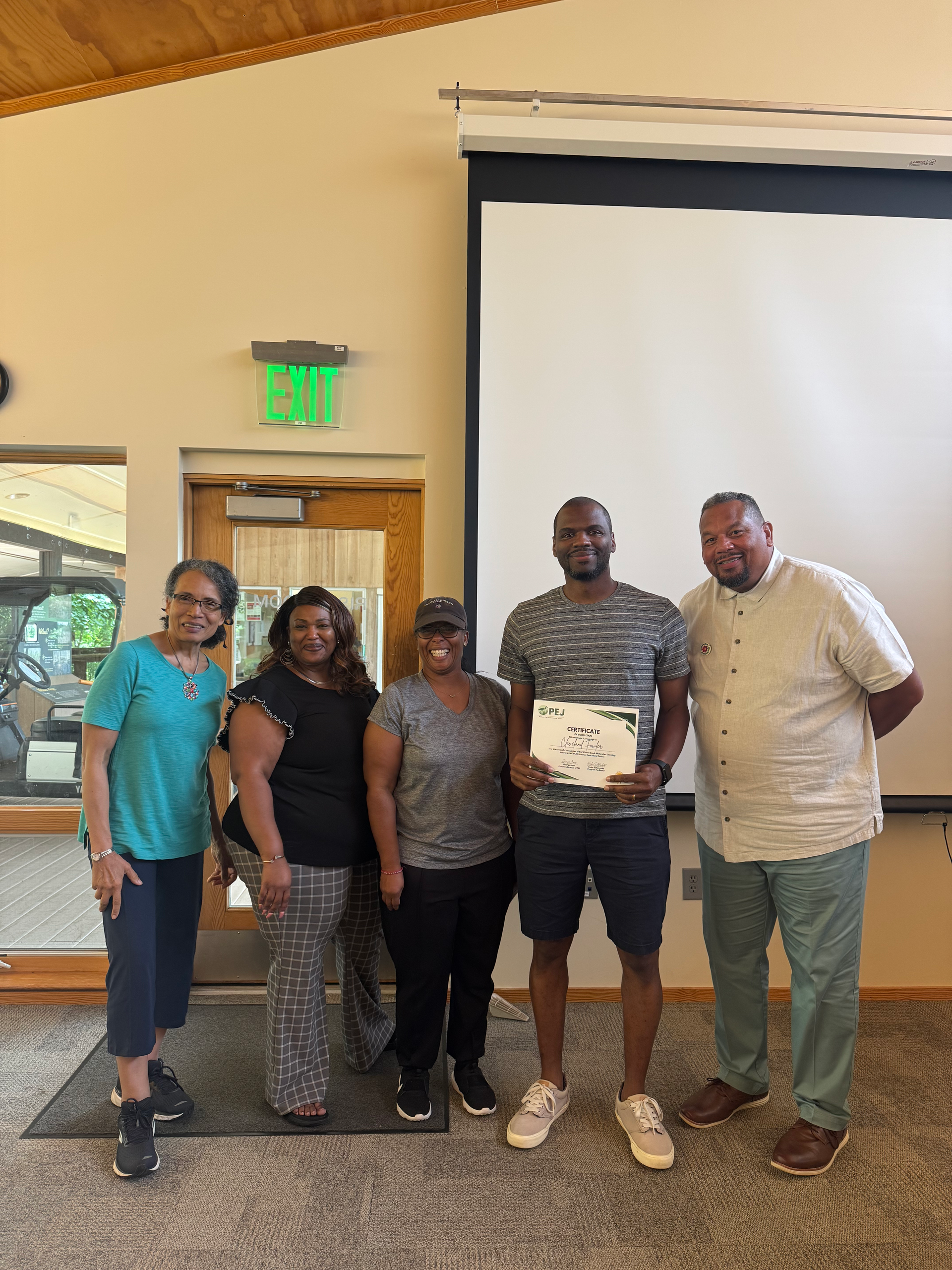
PEJ has conducted 7 WCWLNs with about 200 graduating members!
A classroom with students attending a presentation; a projector displays a blue screen. Two presenters stand near the screen.

Three Core Objectives

A black and white abstract design with a series of overlapping curved lines. The lines create a circular shape.

Build Climate-Literate Resident Cohorts
Equip residents—especially those in flood-prone areas and urban heat islands—with knowledge about local climate risks, environmental justice, and civic engagement to empower informed participation in resilience efforts.


A black sunburst emblem with a white dot in the center, on a white background.

Empower Communities to Act Independently
Strengthen the ability of vulnerable neighborhoods to take initiative on climate resilience by connecting them with decision-makers, funding opportunities, and other key resources.


A black globe with intersecting lines, representing a stylized atom, on a white background.

Inform City Resilience Planning with Community Input
Ensure that resident voices and neighborhood-level planning shape Raleigh’s broader climate resilience programs and infrastructure decisions.

Check out our community projects:

PEJ is focused specifically on

Establish Community Learning Networks Based on Risk Levels

This project will focus on identifying neighborhoods that face increased risks from hazardous flooding and heat vulnerability. Residents in these high-risk areas will be invited to participate in community learning networks. These networks will offer training sessions that introduce technical information about climate risks, provide opportunities for government staff to share available services and explain how to navigate public processes, and feature expert-led discussions on climate science, environmental justice, and the historical context of climate action. In addition, participants will receive financial support to carry out their own climate resilience initiatives.


The goal of this work is to prepare residents to take actions that build community adaptive capacity by developing:

Understanding of Climate Risks: including how to interpret relevant climate data and future projections of climate hazard impacts. The project will utilize Floodplain maps, heat maps created through partnership with NOAA and NWS, and climate data from NOAA assets such as the Fourth National Climate Assessment (NCA4) and North Carolina Climate Science report. 

Understanding of Environmental Justice: an understanding of historical patterns of environmental impacts in Raleigh and the social dynamics of those patterns of impact. 

Adaptive capacity: knowing how to implement autonomous actions residents to protect households and prepare for climate hazards, as well as provision of support to implement a project action as part of the course modules. 

Advocacy capacity: an understanding of the essential functions of City, County, and State governments, relationships with local government staff, how to engage decision makers and participate in governance processes, and advocate for services and infrastructure improvements to address climate hazards. 

TIMELINE

Timeline of Watershed Learning Network (WLN)

  • Peer Exchange in Atlanta shared Watershed Learning Network Concept
  • PEJ, The Conservation Fund (TCF), & J. Turner Consulting apply for grant funding

  • Grant funding awarded by the Triangle Community Foundation & Matching by TCF
  • Additional Funding awarded by National League of Cities

  • PEJ hired first Program Director
  • WLN Curriculum Developed
  • First Learning cohort Spring 2021

  • Additional funding from Town of Cary

  • Second learning cohort Fall 2023
  • Additional funding from Duke Energy

  • Additional funding from NOAA Environmental Literacy Program
  • Curriculum expanded to climate and heat island
  • Third Learning cohort Summer 2024
  • Fourth learning cohort Fall 2024

  • Spring cohort 2025 (Foundations of Water Education)
  • Summer cohort 2025 (Heat Islands and Emergency Preparedness)
  • Fall cohort 2025 (Watershed Action Plan)

A silhouette of a bird flying over a body of water.
Reach out to learn more about visiting the wetlands or how you can support their continued restoration and preservation.

Have Questions or Want to Get Involved?